Why Optimizers Cost You Energy When There's No Shading
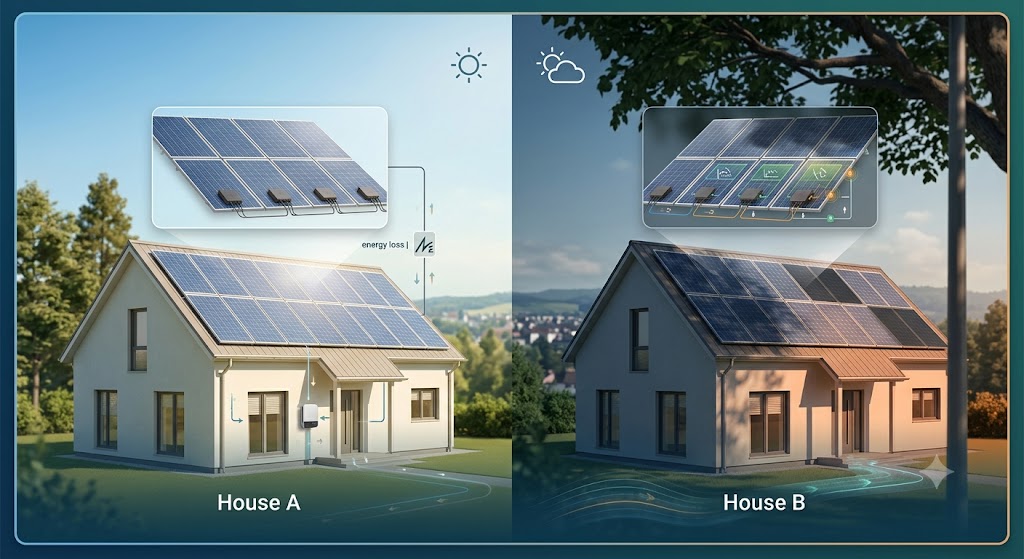
Short version: In a clean, unshaded array, every extra electronic box between the module and the inverter introduces conversion losses and self-consumption without giving you any energy back. Modern string inverters already track the string's maximum power with very high efficiency. So, if there's no shade (and no mix of orientations/ages), optimizers usually reduce net yield.
What Optimizers Do (and Why They Help Only Sometimes)
Module-level power electronics (MLPE, "optimizers") sit behind each PV module and run a DC-DC converter with its own MPPT so each module can operate at its individual maximum power point. This is valuable when:
- Parts of the array are regularly shaded
- Strings mix different orientations, tilts, or ages
- Code demands module-level shutdown/monitoring
Remove those conditions and the optimizer has nothing useful to correct — yet it still converts power (and consumes a bit itself).
Where the Losses Come From
An optimizer's converter is never 100% efficient. Even with excellent design, the weighted efficiency is below 100%. That missing fraction becomes heat — lost energy, all day long.
The electronics (controller, gate drivers, comms) draw power even at low irradiance. Multiply a small standby draw by every module and by 8,760 hours/year — it adds up.
Each device adds contact resistance and a little extra cable. The loss per module is small, but across a field it's measurable.
Optimizers continuously search for MPP. In uniform, stable conditions, a good string inverter already sits essentially at the optimum. Parallel MPPT at module level yields no extra benefit but still incurs overhead.
Why String Inverters Are Already "Good Enough" When Unshaded
- High MPPT efficiency: Modern string inverters routinely achieve >99% MPPT tracking efficiency.
- Low manufacturing mismatch today: Module binning and tighter production tolerances keep mismatch among modules well under ~1%.
- Multiple MPPT inputs: Most inverters offer several MPPTs. You can split roof planes or strings cleanly without MLPE.
A Grounded Energy Example
Assume a 10 kWp unshaded array. Baseline yield: ~15,000 kWh/yr. With optimizers added:
- Converter loss 0.5–1.5% → ~75–225 kWh/yr lost
- Quiescent draw per module × array → ~28–84 kWh/yr
- Extra connectors/wiring → ~5–15 kWh/yr
Net penalty: ~0.8–2.0% (≈ 120–300 kWh/yr on 10 kWp) — with no shading benefit to offset it.
When Optimizers Are Worth It
- Predictable hard shading (chimneys, trees, neighboring buildings) during meaningful portions of the day
- Mixed orientations/tilts/ages on the same MPPT that can't be separated electrically
- Per-module rapid shutdown or monitoring mandated by local code
- A design constraint that genuinely needs DC-DC conditioning
In unshaded, uniform arrays, optimizers add conversion and standby losses without unlocking extra energy. The result is lower net yield, higher complexity, and higher lifetime cost. Choose clean string design with a quality inverter unless real-world conditions — shade, layout, or code — demand otherwise.
Questions about solar for your property?
Our experts are ready to help with a free consultation and personalised savings analysis.
Contact Our Experts →