Low Voltage vs High Voltage Battery Systems: What Actually Matters
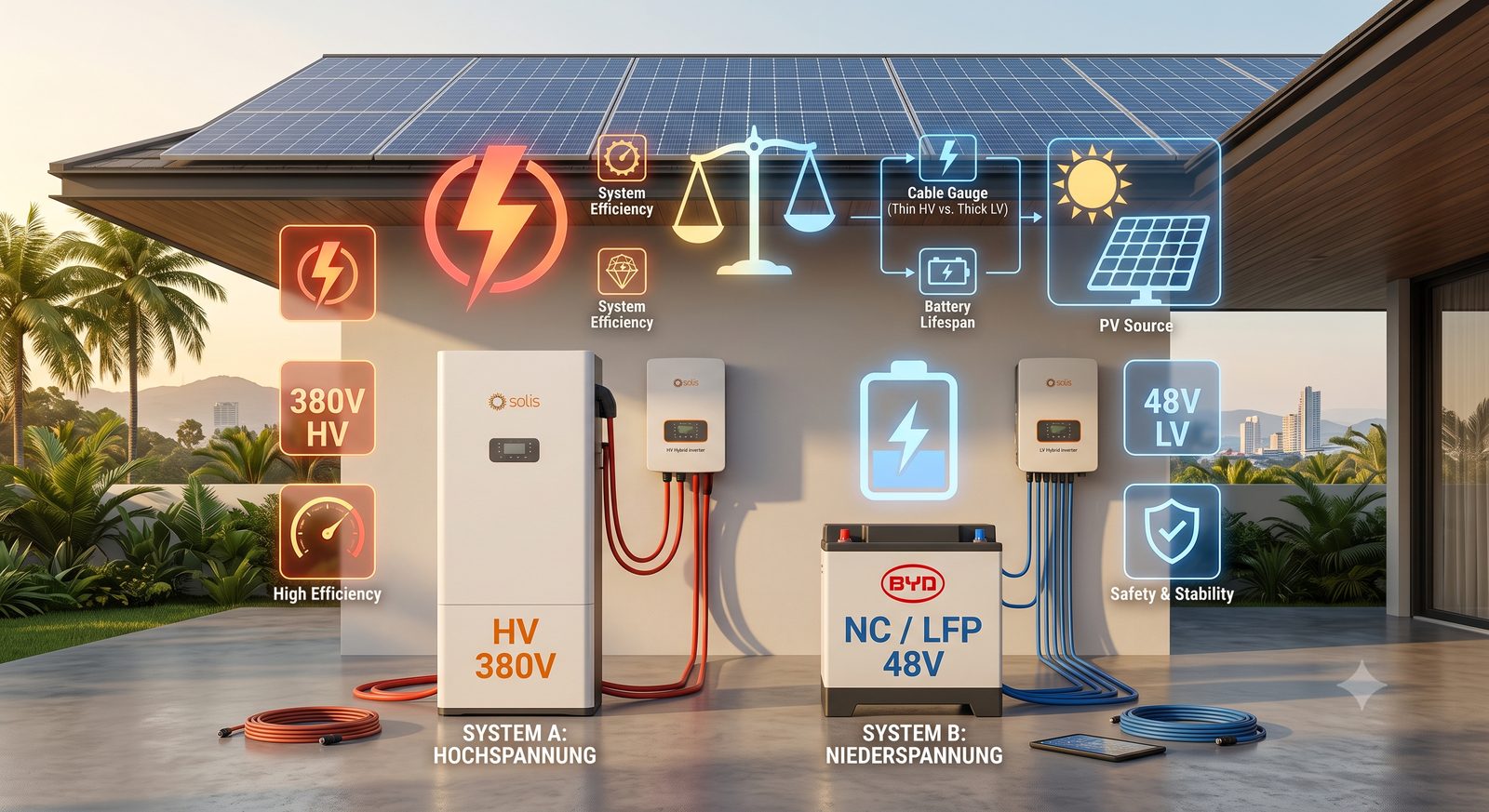
Home battery systems come in two families. Low-voltage systems operate around 48 volts, high-voltage systems typically between 100 and 400 volts. Both are sold as the safer, better choice, often with confident claims on either side. The engineering reality is more balanced - and the differences that matter in practice are not the ones usually advertised.
First, a Common Misconception
It is often claimed that high-voltage batteries run hotter because they carry more current. The physics is the other way around. For a given amount of power, higher voltage means lower current, and resistive heating rises with the square of current. A 5 kW load draws about 104 A at 48 V, but only around 25 A at 200 V.
This is why high-voltage systems can use thinner cables and generally achieve slightly higher round-trip efficiency. Low-voltage systems move the same energy at much higher current, which makes cable cross-section, terminal torque and connection quality far more critical. In a low-voltage installation, a loose or undersized connection is the most common source of heat.
Chemistry Is a Separate Question
Voltage class and cell chemistry are frequently confused. It used to be broadly true that low-voltage home storage used lithium iron phosphate (LFP) while high-voltage packs used nickel manganese cobalt (NMC). That distinction has largely disappeared. LFP is now standard across both classes for stationary home storage.
This matters because chemistry, not voltage, is what governs thermal runaway behaviour. LFP is markedly more thermally stable than NMC and far less prone to runaway. So the right question to ask an installer is not "is it low or high voltage" but "which cell chemistry, and from which manufacturer".
The Differences That Do Matter
48 V is below the threshold generally treated as hazardous to touch. Several hundred volts DC is not, and cannot be safely interrupted without proper isolation. This makes low-voltage systems more forgiving to service and better suited where local technicians handle maintenance.
High-voltage systems lose less energy in the cables and typically achieve 1 to 3% better round-trip efficiency. Over a system lifetime that is real, though modest. Low-voltage systems need heavier copper and careful terminations to reach comparable results.
Low-voltage systems are usually easier to expand module by module and often allow individual modules to be replaced. High-voltage stacks tend to be more tightly matched, which can mean replacing more than the faulty unit.
The battery must match the inverter. This is frequently the real constraint - the choice is often decided by which hybrid inverter suits the property, not by an abstract preference for a voltage class.
What We Recommend
For typical residential installations in Thailand we favour low-voltage LFP systems. The reasoning is practical rather than ideological: service and fault-finding can be carried out safely by local technicians, modules can be added as consumption grows, and LFP tolerates Thai ambient temperatures well. The small efficiency advantage of high voltage rarely outweighs those benefits at household scale.
For larger commercial installations the balance shifts. Above roughly 30 kWh of storage, the reduced current, smaller cabling and better efficiency of high-voltage systems become genuinely significant - and these sites usually have qualified personnel and proper isolation procedures in place.
Neither voltage class is inherently unsafe. Safety comes from cell chemistry, a competent battery management system, correct installation and a manufacturer who will still be supporting the product in ten years. We select the class that fits your system and your site - and we are happy to explain exactly why in your specific case.
Questions about solar for your property?
Our experts are ready to help with a free consultation and personalised savings analysis.
Contact Our Experts →