Solar Batteries in Thailand: When Storage Actually Pays Off
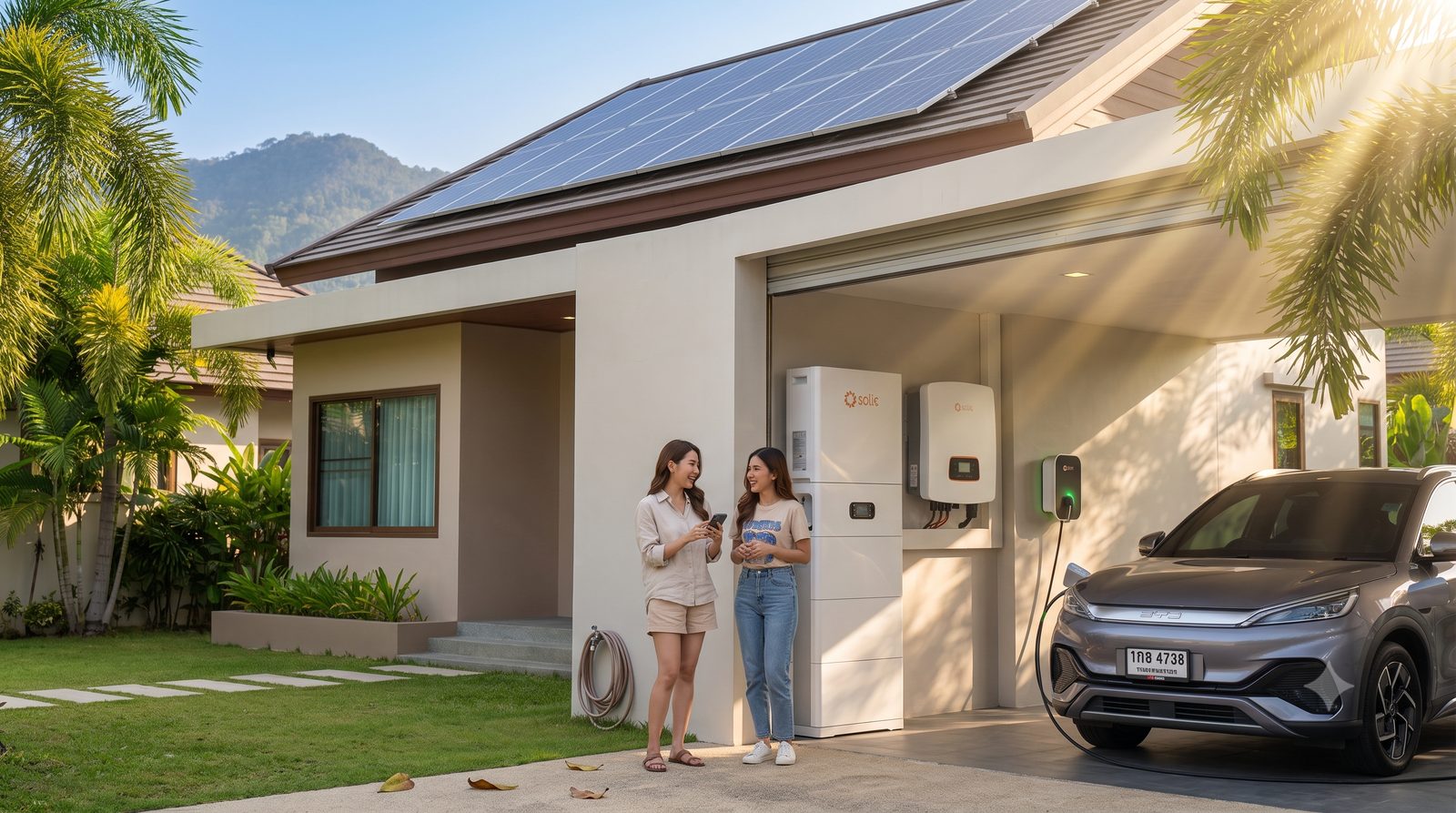
Battery storage is the most debated part of any solar quote in Thailand. Batteries promise independence and blackout protection, but they also carry the largest share of the cost. The honest answer is that storage makes excellent sense for some properties and very little sense for others - and the deciding factor is your consumption pattern, not the technology itself.
The Numbers That Actually Matter
Residential electricity in Thailand currently costs roughly 4.00 to 4.20 THB per kWh including Ft adjustment and VAT. Every kilowatt-hour you take from your own battery instead of the grid saves you that amount. A 10 kWh battery cycled once daily therefore offsets around 40 THB per day, or roughly 14,000 THB per year.
Battery prices have fallen substantially over the past two years. Lithium iron phosphate (LFP) storage now typically adds 100,000 to 200,000 THB to a residential system depending on capacity. That puts realistic payback for a well-sized battery in the range of 7 to 10 years, against a service life of 10 to 15 years and 6,000 or more charge cycles.
Why Storage Became More Attractive in 2026
Thailand runs a net billing scheme, not full net metering. Exported solar is bought by PEA or MEA at about 2.20 THB per kWh - roughly half of what you pay to buy it back at night. In practice a slot is still hard to obtain: the residential round is capped per meter and allocated first come, first served. The authorities have signalled they want to make access easier, so this should improve - but today it remains difficult.
This is what makes storage interesting. Every kilowatt-hour you store and use yourself is worth around 4.10 THB. Exporting is worth 2.20 THB - if you can get a slot at all. Self-consumption is therefore worth almost twice as much, and a battery is what shifts midday surplus into the evening peak.
When a Battery Is Clearly Worth It
Households running air conditioning, pool pumps or EV charging after sunset benefit most. The larger your evening load, the faster the battery pays for itself.
If your area suffers regular outages, a hybrid system with backup circuits keeps essential loads running. For a home office or a business, a single avoided outage can be worth more than a year of savings.
Where a grid connection would cost hundreds of thousands of baht, storage is not a luxury - it is the cheapest available option, and far quieter and cleaner than a diesel generator.
When It Is Better to Wait
If your consumption is concentrated in daylight hours, a straightforward on-grid system already captures nearly all the benefit. A battery would then sit mostly idle and add cost without adding much value. The same applies if your monthly bill is modest - below roughly 3,000 THB there is simply not enough consumption to amortise the extra investment in a reasonable time.
One point deserves care: in a hybrid system the inverter is a single point of failure. If it fails, both your solar production and your backup supply stop until it is repaired. This is a strong argument for choosing well-supported brands with local service and spare parts, rather than the cheapest available unit.
Storage in Thailand is no longer a question of if, but of sizing. For homes with meaningful evening consumption or an unreliable grid connection, a properly dimensioned battery now pays for itself well within its service life. For daytime-heavy usage, the money is better invested in more panels. We size every system around your actual load profile - not around a catalogue.
Questions about solar for your property?
Our experts are ready to help with a free consultation and personalised savings analysis.
Contact Our Experts →